Some of the following facts may be known to you. These facts were recently published in a German magazine, which deals with WORLD HISTORY FACTS ABOUT INDIA
1. India never invaded any country in her last 1000 years of history.
2. India invented the Number system. Zero was invented by Aryabhatta.
3. The world's first University was established in Takshila in 700BC. More than 10,500 students from all over the world studied more than 60 subjects.. The University of Nalanda built in the 4th century BC was one of the greatest achievements of ancient India in the field of education.
4. According to the Forbes magazine, Sanskrit is the most suitable language for computer software.
5. Ayurveda is the earliest school of medicine known to humans.
6. Although western media may portray modern images of India as poverty stricken and underdeveloped country and political corruption, India was once the richest empire on earth.
7. The art of navigation was born in the river Sindh 5000 years ago. The very word "Navigation" is derived from the Sanskrit word NAVGATIH.
8. The value of pi was first calculated by Budhayana, and he explained the concept of what is now known as the Pythagorean Theorem. British scholars have last year (1999) officially published that Budhayan's works dates to the 6th Century which is long before the European mathematicians.
9. Algebra, trigonometry and calculus came from India . Quadratic equations were by Sridharacharya in the 11th Century; the largest numbers the Greeks and the Romans used were 106 whereas Indians used numbers as big as 10 53.
10.. According to the Gemological Institute of America, up until 1896, India was the only source of diamonds to the world.
11. USA based IEEE has proved what has been a century-old suspicion amongst academics that the pioneer of wireless communication was Professor Jagdeesh Bose and not Marconi.
12. The earliest reservoir and dam for irrigation was built in Saurashtra.
13. Chess was invented in India .
14.. Sushruta is the father of surgery. 2600 years ago he and health scientists of his time conducted surgeries like cesarean section, cataract, fractures and urinary stones. Usage of anaesthesia was well known in ancient India .
15. When many cultures in the world were only nomadic forest dwellers over 5000 years ago, Indians established Harappan culture in Sindhu Valley ( Indus Valley Civilisation).
16. The place value system, the decimal system was developed in India in 100 BC.
Tuesday, December 05, 2006


Friday, December 01, 2006
MUMBAI VISITS STONE AGE ! ! SHAMEFUL ! !

How can MAHARASHTRIANS who are supposed to be one of the most civilised population in the country behave so irresponsibly. More than 4 people have lost their lives i
This is definitely not a good sign and we must try to avoid such incidences in future . Or we should be prepared for losing all the possible opportunities of development. I don't want to say that such incidences should be altogether neglected but we should understand the motive of these antisocial elements to spread a feeling of insecurity between the INDIANS amongst themselves. We should show some prudence and understand the motive of antisocial elements . Rioting and arson like yesterday only show that we have become intolerant and indirectly serving the purpose of these antisocial elements.
It is very disheartening to see DECCAN QUEEN be torched irresponsibly. I pray to god that such incidences are not repeated in future.
Link
Wednesday, November 29, 2006
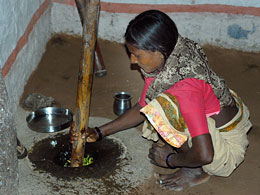
HOW MIROFINANCE is HELPING POOR INDIANS !
This is a story of a poor INDIAN FAMILY living in the poorest conditions where any finance from a conventional bank was impossible to come by and the credit provided by private money lenders was nothing but a trap with no escape route. At this point PENTAMMA mother of two leaving with husband who earned Rs.30(O.69 $) was given a loan by a voluntary organisation - SKS (SWAYAM KRISHI SANGAM) to start her own new venture to earn a living and she succeeded and now lives a conservative but respected life on her own .This is a story of PENTAMMA from a nondescript village in INDIA. Today she lives a life where she supports the family and also inspired other ladies in village and formed a self help group.

Tuesday, November 28, 2006
MICROFINANCE - A NEW TOOL TO FIGHT POVERTY!
ABOUT MICROFINANCE AND MICROCREDIT
History — Microfinance emerged in the 1970s as social innovators began to offer financial services to the working poor — those who were previously considered “un-bankable” because of their lack of collateral. Once given the opportunity, not only did clients of MFIs expand their businesses and increase their incomes, but their high repayment rates demonstrated that the poor are capable of transforming their own lives given the chance. This model of lending disproved all conventional thinking. Microfinance was born. Since then, microfinance has become one of the most sustainable and effective tools in the fight against global poverty.
How microfinance works — The most common microfinance product is a microcredit loan — usually less than $100. These tiny loans are enough for hardworking micro-entrepreneurs to start or expand small businesses such as weaving baskets, raising chickens, or buying wholesale products to sell in a market. Income from these businesses provides better food, housing, health care and education for entire families, and most important, additional income provides hope for a better future.
In addition, the poor, like all of us, need a secure place to save their money and access to insurance for their homes, businesses and health. Microfinance institutions (MFIs) are now innovating to help meet these needs, empowering the world’s poor to improve their own lives.
The global repayment rate for microcredit loans is higher than 95 percent, which allows MFIs to re-lend these funds to even more clients. By giving the world’s poor a hand up, not a handout, microfinance can help break the cycle of poverty in as little as a single generation.
DETAILS ABOUT MICROFINANCE
The traditional banking system requires that a borrower have collateral to receive a loan. The world’s poorest people have no such collateral. Further, traditional banks are not generally interested in issuing small loans — $50 to $150 — as the interest benefits do not exceed the transaction costs. That said, how has microfinance been so successful?
Microfinance institutions exist in many forms — credit unions, commercial banks and, most often, non-governmental organizations (NGOs). Many microfinance institutions (MFIs) use social collateral in the form of peer groups to ensure loan repayment. Borrowers take out loans in groups of five to eight individuals. If a borrower defaults on her loan, the entire group typically is penalized and sometimes barred altogether from taking further loans. This peer pressure encourages borrowers to be very selective about their peer group members and to repay loans in full and on time, resulting in the higher than 95 percent repayment rates industry-wide.
Microcredit loan cycles are usually shorter than traditional commercial loans — typically six months to a year with payments plus interest, due weekly. Shorter loan cycles and weekly payments help the borrowers stay current and not become overwhelmed by large payments.
Clearly the transaction-intense nature of weekly payment collections, often in rural areas, is more expensive than running a bank branch that provides large loans to economically secure borrowers in a metropolitan area. As a result, MFIs must charge interest rates that might sound high — the average global rate is about 35 percent annually — to cover their costs.
For a financial institution to scale and remain sustainable, at a bare minimum it has to cover its costs. In the example below, a large bank (big lender) can charge anything over 14 percent to recoup its costs, whereas the MFI has to charge a rate of at least 31 percent to cover its costs.
INDIA HARD FACTS ! !
The Need in India
* India is said to be the home of one third of the world’s poor; official estimates range from 26 to 50 percent of the more than one billion population.
* About 87 percent of the poorest households do not have access to credit.
* The demand for microcredit has been estimated at up to $30 billion; the supply is less than $2.2 billion combined by all involved in the sector.
* About 87 percent of the poorest households do not have access to credit.
* The demand for microcredit has been estimated at up to $30 billion; the supply is less than $2.2 billion combined by all involved in the sector.
GRAMEEN BANK - A PROJECT WORTH IMITATING IN INDIA!!
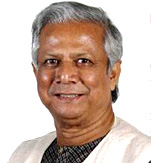
GRAMEEN BANK is a non-coventional banking organisation founded by MR.MUHAMMAD YUNUS, a BANGLADESHI and now a NOBEL LAUREATE who was awarded NOBEL PEACE PRIZE for 2006.
BANGLADESH,erstwhile east pakistan, was created after INDO-PAK war in 1971.BANGLADESH separated from bengal province of INDIA during partition of INDIA in 1947.Liberation of BANGLADESH was a major blow to TWO NATION THEORY of MR. JINNAH,creator of PAKISTAN.However after liberation,BANGLADESH as a nation comprised of Muslims majority population which was illiterate and depended heavily on agriculture.The situation in BANGLADESH was no different at the time of independence than at time of partition. Politically ,too,BANGLADESH has had turbulent past surviving years of dictatorship.
Democracy,still in its early stages, is far from being mature democracy as in INDIA.With all these factors it was no surprise that BANGLADESH was considered to be one of the poorest and least developed nations in the world.
GRAMEEN BANK ,literally meaning -rural bank, was founded in BANGLADESH with an intention to help the average bangladeshi to become self reliant and independent. MR. MUHAMMAD YUUNUS, founder of GRAMEEN BANK, after finishing his education returned to his home country and decided to venture into a project - to provide loan to the poorest especially women to start their own business to help support themselves and their family.The amount given as a loan was small and most importantly it was given without any collateral. This was a revolutionary approach and contrary to the system of conventional banks.This helped these poor people who now had some money at hand without the exuberant interest rates of private money lenders.This system of finance-microfinance did wonders to lives of these poor people who grabbed the opportunity with both hands and did their best.This project has been hugely successful in the world and more so in BANGLADESH. This project has by now transformed the lives of millions of poor Bangladeshis.Impressed by the success of GRAMEEN BANK GOVERNMENT OF BANGALADESH pitched in and provided state funding.MR.MUHAMMAD YUNUS got the due recognition and was awarded NOBEL PEACE PRIZE for 2006.Now the UN has decided to start similar projects world over as part of poverty alleviation policy. Other voluntary organisations are also implementing such projects world over including INDIA.
Interestingly, when the conventional financial institutes are worried about repayment of loans provided by them after collateral guarantees the repayment history of GRAMEEN BANK and similar micro finance organisations has been more than 95% and in some cases 100% -all this without collateral.
In INDIA similar microfinance organisations are working for the upliftment of the poor in INDIA.But the sheer size of the needy population is a big hindrance for their work to show any significant impact.
Friday, November 24, 2006
INDIA is ROCKING!!
YES, my FRIENDS,
INDIA is ROCKING and so re INDIANS. This fact is amply highlighted by ANNUAL REPORT about richest people on earth.This list includes awesome number of INDIANS owning awesome amount of money.INDIA's rising fortunes are underscored by the increasing prosperity of its wealthiest citizens. Members of our third annual ranking of India 's 40 richest businesspeople are worth a collective $170 billion, up from $106 billion last year. India 's top ten, worth $112 billion, account for two-thirds of that wealth. This list includes 40 INDIANS from diverse group of companies.
But this is not going to be sufficient ; INDIA can not become a superpower or a developed nation by having few people having maximum money. That will require more and more INDIANS becoming more and more self sufficient and independent.
Wednesday, November 22, 2006

Tuesday, November 21, 2006
HEALTH INDIA !

You will see whole of INDIA is in RED that means INDIA in spite of all its so called progress , is still a long way from even being average in terms of health care !! Hoe re we going to achieve it ? Do u think only government efforts can make it possible?
Tuesday, November 14, 2006


DO THESE PICTURES MAKE YOU FEEL PROUD ON CHILDREN'S DAY?
This is a sorry situation of underpreviledged children inINDIA ! These pictures speak for themselves! I dont need to explain it. Everyone says INDIA's potential is in its YOUTH , the young population , which is the most dependable and the most productive population in demography.How this population is going to build strong future for INDIA when their own life is spent on effort to make both ends meet ! These children are in most cases doing this not willingly butas a compulsion .Dont we need to do something to abolish it? I dont think laws banning CHILD LABOUR have failed miserably to abolish CHILD LABOUR from INDIA. So citizens need to take an initiative to do this. Through this blog I wish to invite suggestons to abolish this menace from society.
So do send your valuable suggestions!!!!
Saturday, November 11, 2006


SUPREME COURT OF INDIA IS RUNNING THE COUNTRY!!
Recent article in TIME magazine has brought in focus this matter.Yes, there is every reason to believe that SUPREME court of INDIA is running the country.And no, it is not by choice but by default.When the elected Representatives that includes all politicians of this great country forget their duty and keep personal and electoral gains above the interest of common man; someone has to pitch in and reassure the average INDIAN .The SUPREME COURT OF INDIA and the other judicial machinery has actively pitched in to undo wrongdoings of other two pillars of INDIAN democracy - bureaucracy and elected representatives.
On more than few occasions, supreme court overruled the decisions taken by bureaucracy and elected representatives, citing interest of common man at large!
These are a few examples to quote a few :
1) Delhi high court whipped (verbally) the police investigating JESSICA LAL murder case and directed the police to reopen the case and do fresh and sincere investigation into the case to nail the culprit.
2) SUPREME COURT , giving judgement, ordered the DELHI MUNICIPAL CORPORATION to seal all illegal residential and commercial buildings an DELHI. This was done in larger public interest when the official machinery and the elected representative in DELHI were going out of the way to protect these illegal structures.
3) Increase in reservation quota in educational institutes and - both government and private ; and job reservations in private sector. Had it not been the order passed by supreme court in which it ordered the government to justify increase in reservations , government , in all probabilities would have passed the law by now.
There are many such examples which justify the question raised by TIME magazine.
At this point I just wish to ask you all : Imagine , just imagine what would have happened to this great country if judiciary wouldn't have been active? The fallout have been unthinkable.
Thanks to the foresight of our forefathers who created a strong judiciary system in INDIA!!!!!
Subscribe to:
Posts (Atom)


